An ExecAtlas representative will contact you shortly.
Our Website Uses Cookies
By clicking "Accept All", you agree to the storing of cookies on your device to enhance site navigation, analyze site usage, and assist in our marketing effort. View our Privacy Policy for more information.
These cookies are essential for moving around the website and using its features. Convenience features such as your login status and browser based optimizations all ensure performance and a good basic experience.
Functional
These cookies allow the website to remember the choices you make to provide personalized features. They are anonymous and do not track across different websites.
Analytics
These cookies will monitor website performance and data about how visitors use our website. They help us understand how to improve our service and to determine where improvements can be made.
Executive Relationship Mapping 101: How to Find Paths to Any Decision-Maker
January 20, 2026
Share
Most sales teams know exactly who they need to reach. The persona is defined. The executive's name is in the CRM. Their title is confirmed. LinkedIn shows they're the decision-maker.
But knowing who to reach and knowing how to reach them are two different problems.
Without relationship mapping, even experienced sellers default to cold outreach because they lack visibility into warm paths. The result is predictable: low response rates, longer sales cycles, and deals that stall at the executive level.
Executive relationship mapping solves this. It reveals trusted introduction paths by charting who-knows-who across your organization's network, your prospects' networks, and the broader executive ecosystem.
This guide explains what relationship mapping is, how to operationalize it, and how to scale it across your go-to-market team.
What You’ll Learn
How to identify trusted paths to executives through overlapping work histories, board memberships, and professional networks
The three-layer framework for mapping internal networks, extended connections, and real-time relationship tracking
Industry-specific approaches to relationship mapping in Investment Banking, Legal Services, and B2B Tech
How to prioritize warm introduction paths based on relationship strength and recency
How to scale relationship mapping across your sales team through CRM integration and repeatable processes
What Is Executive Relationship Mapping?
Executive relationship mapping is the systematic process of identifying who in your organization or extended network has a trusted connection to a target decision-maker.
It's not informal networking or asking "Does anyone know someone at this account?" in Slack. It's structured visibility into:
Overlapping work histories between your team and target executives
Shared board memberships and advisory roles
Alumni networks and professional affiliations
Historical relationships that remain active even years later
The goal is simple: find the shortest, strongest path from your organization to the executive you need to reach. Once you've mapped that path, you can request a warm introduction (a Power Intro) instead of relying on cold outreach.
Why it matters: Engaging an executive through a warm introduction generates a 46% response rate, compared to 3% for cold outreach. That's a 15x difference in your ability to start a conversation.
When you map relationships systematically, you replace hope-based outreach with repeatable access.
The Three Layers of Effective Relationship Mapping
Relationship mapping works across three layers: internal networks, extended networks, and real-time tracking. Each layer builds on the previous one to create comprehensive visibility.
1. Internal Network Mapping
Start with who you already know.
Your sales team has direct connections, but the richest paths often exist outside the sales org. Engineers, product leaders, finance teams, and executives all carry networks from past roles that remain active.
What to map:
Direct connections across your entire organization
Shared employers between your employees and target executives
Alumni networks (university, previous companies, military service)
Not every path is one degree away. The most valuable connections are often two degrees out, where someone in your network knows someone who knows your target.
This layer focuses on overlapping experiences that create trust even without direct contact.
What to map:
Second-degree connections through shared employers (overlapping tenures)
Board service overlaps (executives who served on the same board, even years apart)
Industry associations, speaking circuits, or executive programs
Investor and advisor relationships in private companies
Extended network mapping uncovers warm introduction paths that cold outreach would never reveal.
3. Real-Time Relationship Tracking
Relationships aren't static. Executives change roles, join boards, and move companies constantly. A strong path today can disappear tomorrow. A cold account can become warm overnight.
Real-time tracking keeps your maps current.
What to track:
Executive transitions (promotions, new roles, retirements)
Board appointments and departures
Company events (M&A, leadership changes, restructuring)
Your own team's network changes as employees join and leave
Tracking executive transitions in real time means you can activate warm introduction paths immediately when they emerge.
How Relationship Mapping Works Across Industries
Different industries require different approaches to relationship mapping. The paths that matter, the buyer motion, and the relationships that carry weight vary significantly across verticals.
Investment Banking: Coverage Relationships and Deal Flow
Investment banking relationships are built on coverage history and deal execution. Bankers who covered an industry or worked on mandates together maintain active relationships for years, even across firms.
What to map:
Overlapping coverage teams (bankers who covered the same clients or sectors)
Deal teams that executed transactions together
Alumni networks from previous banks (Goldman, Morgan Stanley, JP Morgan)
Board memberships where bankers serve alongside corporate executives
Legal Services: Firm Alumni Networks and General Counsel Relationships
Legal relationships are built on trust developed over years of working complex matters together. General Counsels who worked at the same firm, even a decade apart, maintain relationships that cold outreach can't replicate.
What to map:
Law firm alumni networks (overlapping tenure at major firms)
In-house counsel who worked together at previous companies
Board service (GCs frequently serve on nonprofit or corporate boards)
Bar associations and legal society memberships
B2B Tech: Champion Tracking and Multi-Threading
B2B tech sales rely on champions who advocate internally and buying committees that include multiple decision-makers. Relationship mapping reveals paths to champions and enables multi-threaded outreach across the executive team.
What to map:
Champions who have moved to target accounts
Overlapping work histories between your team and the prospect's leadership
Board members who sit on portfolio company boards (especially in VC-backed companies)
Investor relationships (VCs and angels who can facilitate introductions)
From Map to Meeting: Operationalizing Relationship Mapping
Prioritize the Strongest Paths
Not all relationships are equal. Prioritize based on strength and recency:
Direct connection (worked together in the past year)
Shared employer with overlapping tenure (worked at the same company at the same time)
Board overlap (served on the same board, even in different years)
Alumni networks (same university, same military branch, same professional program)
The closer the relationship and the more recent the interaction, the stronger the path.
Request the Introduction
Once you've identified the path, make the ask. This requires internal alignment.
Provide context on the target executive and why you're reaching out
Make it easy for the connector (draft the intro email, provide talking points)
Follow up quickly once the introduction is made
What doesn't work:
Vague requests ("Can you introduce me to anyone at X company?")
Asking without context (your colleague doesn't know why this matters)
Failing to follow up or provide updates after the intro
Multi-Thread Using Relationship Maps
Buying decisions at the executive level rarely involve a single person. Relationship mapping allows you to reach multiple decision-makers through different warm introduction paths.
Example: You're selling into a financial services firm. You map paths to the CRO (through a shared board connection), the CFO (through an overlapping employer), and the COO (through an advisory relationship). Instead of single-threading through one executive, you can engage all three through trusted introducers.
This approach increases win rates and reduces risk if one champion leaves or loses influence.
Map Proactively and Reactively
Relationship mapping works in two modes:
Proactive: Map target accounts before outreach begins. Identify warm paths during account planning, not after cold outreach fails.
Reactive: Map inbound interest quickly. When a prospect engages, find additional paths to accelerate the deal and expand conversations beyond a single contact.
Scaling Relationship Mapping Across Your Team
Relationship mapping can't be a manual exercise for a few senior sellers. To work at scale, it needs to be embedded in your workflow.
Templatized Processes for AEs
Give your team a repeatable process:
Identify target accounts
Search for warm paths using relationship mapping tools
Prioritize paths based on strength and recency
Request introductions from internal connectors
Track outcomes and update CRM records
Clear steps make relationship mapping a habit, not an ad hoc activity.
RevOps Enablement
RevOps ensures relationship data is clean, current, and governed. This includes:
Defining what counts as a "warm path" vs. a weak connection
Setting expectations for response time on introduction requests
Tracking which relationships convert to meetings and pipeline
Auditing data quality to avoid outdated or incomplete maps
Marketing's Role in Relationship Mapping
Marketing can use relationship maps to personalize ABM campaigns. If your organization has a warm path to an executive, your messaging should reflect that.
Example: Instead of generic cold email copy, reference the shared connection in your outreach. "Our CMO, Sarah Chen, mentioned you both served on the board of TechVentures. I'd love to connect and share how we're helping similar organizations solve [specific challenge]."
This approach increases engagement and differentiates your outreach from competitors who lack relationship context.
How ExecAtlas Enables Relationship Mapping at Scale
Relationship mapping is the discipline. Execution requires visibility into executive networks, real-time tracking, and CRM integration.
ExecAtlas provides verified executive intelligence built from overlapping work histories, board memberships, and career transitions across 600M+ connections. This visibility reveals warm introduction paths across your organization's collective network.
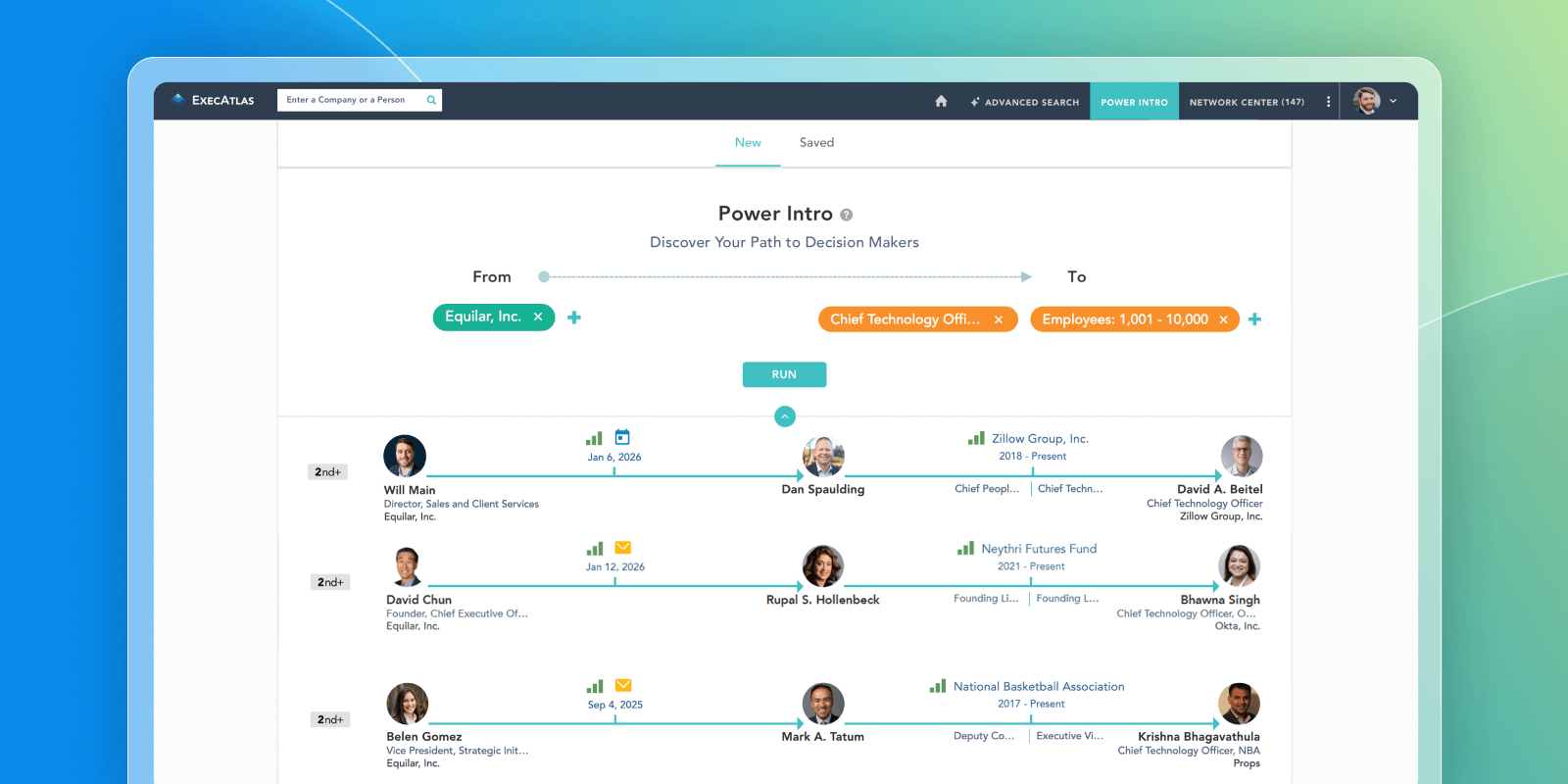
Power Intros are ExecAtlas's mechanism for activating these paths. A Power Intro is a warm introduction facilitated through a trusted connection identified via relationship mapping. Instead of cold outreach, your team requests introductions through colleagues who share past employers, board service, or professional affiliations with target executives.
How ExecAtlas supports relationship mapping:
Automated Path Discovery: Identifies warm introduction paths across internal and extended networks without manual research
Real-Time Alerts: Tracks executive transitions, board appointments, and role changes to keep relationship maps current
CRM Integration: Embeds relationship intelligence directly into Salesforce and other CRMs so paths are visible in existing workflows
Multi-Threading Visibility: Maps paths to multiple decision-makers within target accounts for comprehensive buying committee engagement
The combination of relationship mapping as a discipline and Power Intros as an execution mechanism replaces cold outreach with repeatable executive access.
Ready to see the connections your team is missing?
Small teams can manually map relationships using LinkedIn and public records, but this doesn't scale. ExecAtlas provides automated visibility into work history overlaps, board connections, and real-time executive transitions, integrated directly into your CRM workflow. This eliminates manual research and ensures relationship intelligence is accessible where your team works.
Identify who in your organization shares past employers, board memberships, or professional affiliations with your target executive. Prioritize direct connections and overlapping tenure over distant associations. Request the introduction by providing context on why it matters and making it easy for your colleague to facilitate.
Relationship intelligence is the data showing who-knows-who. Relationship mapping is the process of using that intelligence to identify and prioritize paths to specific executives. Mapping turns intelligence into action by revealing warm introduction paths you can activate.
Integrate relationship mapping into your CRM so warm introduction paths are visible in your team's existing workflow. Create repeatable processes for identifying paths, requesting introductions, and tracking outcomes. ExecAtlas embeds verified executive intelligence directly into Salesforce and other CRMs, making relationship mapping accessible across your entire go-to-market team without leaving familiar tools.
Warm introductions through trusted connections generate a 46% response rate compared to 3% for cold outreach. Executives prioritize requests that come through people they know and trust. Relationship mapping systematically reveals these paths instead of relying on cold tactics that executives ignore.
Yes. Relationship maps allow marketing teams to personalize ABM campaigns by referencing shared connections in outreach. Instead of generic messaging, you can acknowledge the warm path in your communication, significantly increasing engagement rates and differentiating your approach from competitors who lack relationship context.


 Products
 Industries