Executives ignore cold outreach. A cold email to a C-level decision-maker generates a 3% response rate. A warm introduction through a trusted connection generates a 46% response rate. That's a 15x difference.
The problem has never been whether warm introductions work. The problem is execution. Sales teams rely on tribal knowledge about who knows who. Relationship mapping happens manually. Visibility ends at immediate networks. What should be a repeatable motion remains ad-hoc and relationship-dependent.
This guide shows you how to make warm introductions systematic and scalable.
Here's what you'll learn:
-
Why warm introductions outperform cold outreach and why traditional execution methods fail to scale
-
The three-step Power Intro framework for mapping, validating, and executing warm introductions systematically
-
How to apply warm introductions across industries and throughout the sales cycle
-
How technology enables relationship mapping at organizational scale
Why Warm Introductions Work (But Remain Hard to Scale)
Warm introductions work because trust transfers through existing relationships. When someone an executive knows and respects makes an introduction, the referral carries credibility that no cold email can replicate. Executives prioritize conversations from trusted channels. They respond to colleagues, former employers, and board members. They ignore generic outreach.
Warm introductions lead to meetings, reduce perceived risk, and create momentum throughout the sales cycle.
But traditional execution doesn't scale:
-
Relies on tribal knowledge (who knows who isn't documented)
-
Manual relationship mapping is time-intensive and incomplete
-
Visibility rarely extends beyond first-degree connections
-
What works for well-connected reps doesn't translate across the organization
The gap is clear: proven effectiveness without scalable execution.
The Power Intro Framework: Scaling Warm Introductions Systematically
Power Intro is ExecAtlas's methodology and product capability for making warm introductions systematic. It maps relationship paths across your organization's network, validates connection quality, and guides execution so every rep can capitalize on warm introductions regardless of their personal network.
Power Intro delivers:
-
Relationship mapping across 600 million executive connections
-
Work history overlaps, board relationships, and shared professional affiliations
-
Visibility into connections your team didn't know existed
The framework consists of three steps:
The first step is identifying who in your organization has connections to the executives you're targeting. Power Intro automates this by analyzing employment histories and professional networks.
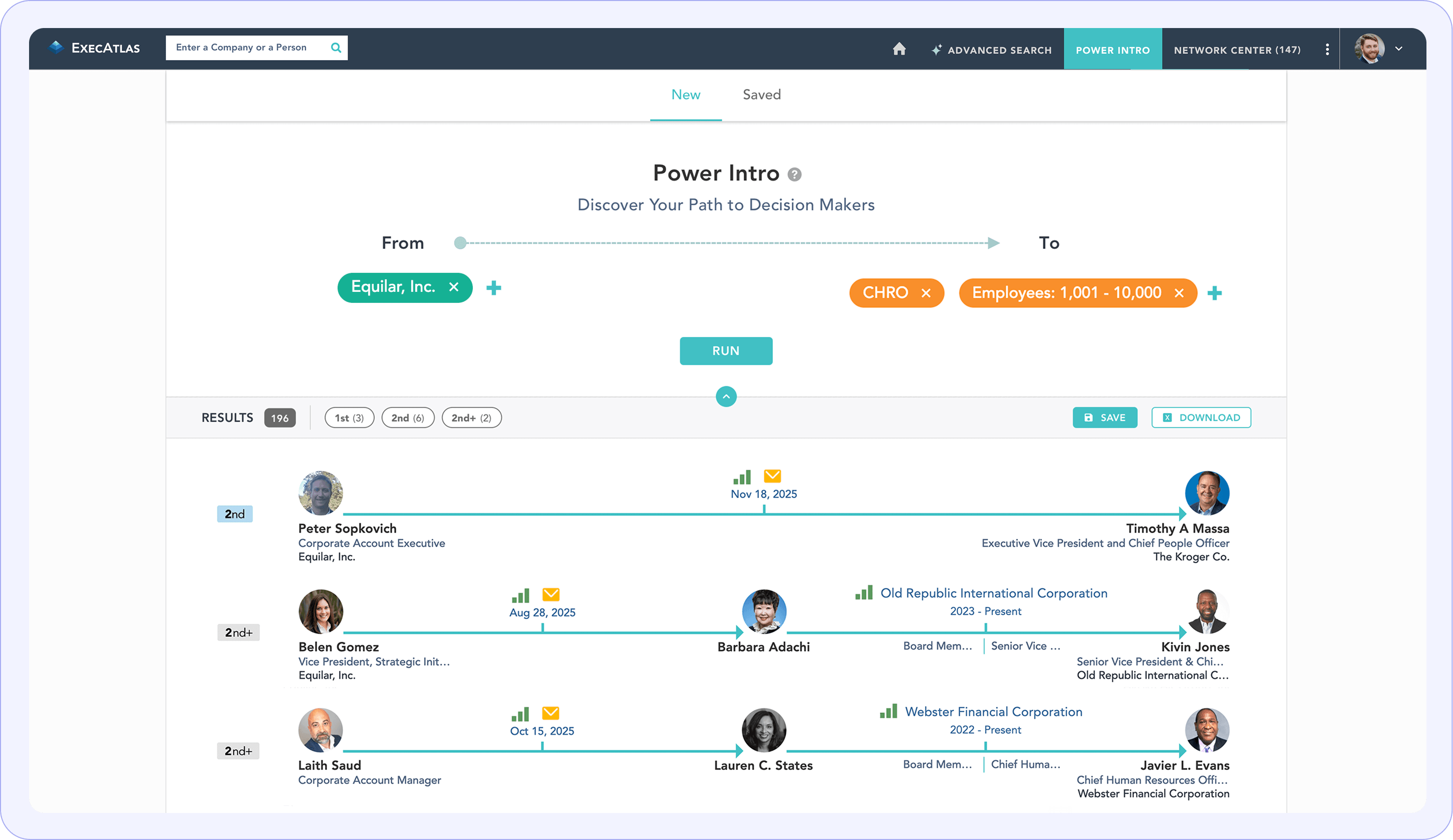
Here’s how it works. Start with any list of contacts (internal or external) you choose. Then choose a target persona you’re looking to reach. You can specify personas based on factors ranging from title to industry to company size.
When you identify a target persona, Power Intro surfaces:
-
Former colleagues at the same company
-
Overlapping board service
-
Multi-hop connections through your network's network
These are verified relationships that exist whether or not they're documented in your CRM or remembered by the individuals involved. Most organizations discover they have far more executive connections than they realized. The challenge was visibility, not absence of relationships.
Not all connections carry equal weight. A former colleague who worked closely with an executive for five years matters more than someone who briefly overlapped in a large organization. Recency matters. Context matters.
Power Intro shows:
This allows your team to prioritize which paths to pursue. Instead of pursuing tenuous connections, you identify the strongest relationships and approach those first.
Once you've identified and validated a strong connection, execution becomes straightforward.
To execute effectively:
-
Brief your introducer on the target executive, business reason, and value proposition
-
Provide context they can reference based on their shared history
-
Make it easy (short email, draft language if helpful)
-
Follow up quickly after the introduction is made
Power Intro guides this workflow by surfacing relationship context, providing visibility into the target executive's background, and tracking follow-up so introductions don't fall through the cracks.
Industry Applications: Warm Introductions in Practice
Warm introductions apply differently depending on industry dynamics and buyer roles.
Banking: Relationship-driven sales to CFOs and Treasurers benefit from warm introductions through shared board service, alumni networks, or prior employment at competing institutions. Investment banking and commercial lending teams use Power Intro to surface connections before pitching M&A advisory or credit facilities.
Legal: General Counsel rarely respond to cold capability pitches. Law firm business development teams use Power Intro to identify which partners share work history with target GCs, then coordinate multi-partner introductions that establish credibility before competitive pitches.
B2B Tech: Sales and marketing technology purchases involve multi-stakeholder buying committees. B2B tech sales teams use Power Intro to multi-thread into CROs, CMOs, and RevOps leaders simultaneously rather than relying on a single champion.
Applications Across the Sales Cycle
Multi-Threading: Map relationship paths to everyone in the buying committee to establish credibility with the economic buyer, technical evaluator, and executive sponsor simultaneously.
Account-Based Engagement: Reveal all connections your organization has across target accounts for coordinated, relationship-driven outreach.
Deal Acceleration: When deals stall, identify warm paths to senior decision-makers who can unstick procurement delays or budget approval bottlenecks.
From Ad-Hoc to Repeatable
The framework outlined here turns relationship advantage into organizational capability. Power Intro makes it systematic.


 Products
 Industries