An ExecAtlas representative will contact you shortly.
Our Website Uses Cookies
By clicking "Accept All", you agree to the storing of cookies on your device to enhance site navigation, analyze site usage, and assist in our marketing effort. View our Privacy Policy for more information.
These cookies are essential for moving around the website and using its features. Convenience features such as your login status and browser based optimizations all ensure performance and a good basic experience.
Functional
These cookies allow the website to remember the choices you make to provide personalized features. They are anonymous and do not track across different websites.
Analytics
These cookies will monitor website performance and data about how visitors use our website. They help us understand how to improve our service and to determine where improvements can be made.
Turn Law Firm Client Records into Revenue with Executive Relationship Intelligence
November 24, 2025
Share
Law firm CRM systems fail because the data inside them is incomplete, outdated, or wrong. Partners don't update records because manual data entry takes time away from billable work. Business development teams can't trust contact information that was accurate six months ago but reflects none of the executive transitions, promotions, or company changes that have happened since. The result is a CRM that exists primarily to satisfy managing partner requirements rather than drive client growth.
The problem isn't CRM adoption. It's data quality. Without verified, continuously updated executive intelligence, even the most sophisticated CRM becomes a repository of stale contact records that no one uses. Legal operations teams spend countless hours chasing attorneys for updates, manually researching executive moves, and trying to maintain data hygiene standards that decay faster than they can be enforced.
Executive relationship intelligence solves this by automatically enriching CRM with verified executive data and relationship maps that make client records actionable. Here's what you'll learn in this guide:
How legal ops teams eliminate manual CRM updates through automated executive intelligence enrichment
Why relationship mapping transforms client records from contact lists into strategic opportunity maps
How real-time transition tracking keeps executive data current without attorney involvement
What clean, relationship-rich CRM data delivers for business development effectiveness
What ExecAtlas Offers Legal Operations Teams
Keeps executive data current: CRM data decays at 30-70% annually as executives change roles, companies merge, and decision-makers move. Legal ops teams can't manually track these changes across thousands of contacts. ExecAtlas monitors executive transitions in real time and automatically updates CRM records, ensuring contact information, titles, companies, and board positions remain accurate without requiring attorney input or manual research.
Reveals relationship paths: Client records contain names and titles but miss the relationship context that enables warm introductions. ExecAtlas maps work history overlaps across 600 million executive connections, showing which partners, counsel, or associates share past employers or board memberships with target executives. This transforms generic contact lists into relationship maps that business development teams can actually use to open doors.
Surfaces timely executive signals: When a General Counsel moves to a new company, when a CFO gets promoted, when a board adds a new member, your CRM should reflect it immediately. ExecAtlas delivers real-time alerts and automatic record updates so legal ops teams maintain data accuracy and business development teams can act on opportunities when timing matters most.
For Legal Operations Directors and Managers, ExecAtlas eliminates manual CRM maintenance, improves data quality systemwide, and transforms client records into revenue-enabling relationship intelligence. For CFOs and Managing Partners evaluating CRM investment, the solution solves the adoption and data quality problems that prevent existing systems from delivering ROI for the firm.
How Executive Relationship Intelligence Changes Revenue Operations at Law Firms
Without relationship intelligence:
Legal ops teams manually chase attorneys for CRM updates that rarely happen, leaving client records incomplete and outdated
CRM contains contact information but lacks relationship context, making it useless for identifying warm introduction paths or connection strength
Partners avoid using CRM because data is unreliable and the system doesn't help them win work or identify opportunities
Executive transitions go unnoticed for weeks or months, causing missed opportunities to re-engage champions or target new decision-makers
With ExecAtlas:
CRM enriches automatically with verified executive profiles, work histories, board memberships, and relationship paths without requiring attorney input
Client records show not just who to contact but which attorneys at your firm have genuine relationships based on past employment overlaps or shared board service
Partners use CRM because it surfaces actionable intelligence that helps them win work rather than requiring administrative data entry
Real-time alerts notify business development and legal ops teams immediately when executives transition, keeping CRM current and creating timely outreach opportunities
The shift is from CRM as an administrative burden to CRM as a business development tool.
Use Cases: How Legal Operations Teams Apply Executive Relationship Intelligence
Auto-Enrich CRM with Executive Intelligence
Most law firm CRMs contain basic contact information but lack the executive profiles, work histories, and relationship context that business development teams need. Legal ops teams spend significant time manually researching executives, updating titles, and tracking transitions. This manual approach can't scale and creates data that's outdated within months.
What this looks like in practice:
Your firm's CRM contains 5,000 executive contacts across target industries, most with incomplete profiles and outdated titles
ExecAtlas integrates with your CRM and automatically enriches records with verified executive data sourced from SEC filings, corporate disclosures, and board records
Each contact now includes complete work history, current board memberships, educational background, and verified employment dates without manual research or data entry
Business development teams access complete executive profiles directly in CRM workflows, and legal ops maintains data quality without chasing attorneys for updates
Stat to know: ExecAtlas audits have revealed that law firm CRMs often miss more than 90% of executives and board members at target clients, as well as two-thirds of primary decision-makers in key accounts.
Create a 360 Degree View of Relationships
Client records show who your firm knows but not who else at your firm knows them or what relationship paths exist to other decision-makers at target companies. Without this visibility, business development teams can't coordinate multi-partner outreach or identify which attorneys should be involved in specific opportunities.
What this looks like in practice:
Your CRM shows that your firm has worked with the General Counsel at a financial services company
ExecAtlas reveals that three other partners have work history overlaps with the CFO, Chief Compliance Officer, and two board members at the same company, relationships that weren't documented in CRM
Legal ops creates a complete relationship map for the account, showing all connection points across your firm
Business development coordinates a multi-threaded engagement strategy that expands the relationship beyond a single practice area and decision-maker
Surface Warm Introductions to Executives
CRM contains thousands of executive contacts, but most business development outreach defaults to cold emails because no one knows which attorneys at the firm have genuine relationships with those executives. Legal ops teams can't manually research every contact to identify connection points.
What this looks like in practice:
A partner wants to reach the General Counsel at a technology company for IP litigation work
ExecAtlas shows directly in the CRM record that another partner worked alongside the General Counsel at a prior company for four years
Legal ops surfaces this warm introduction path without manual research or asking attorneys to recall relationships from memory
The business development team coordinates an introduction, and the General Counsel responds positively based on the existing relationship
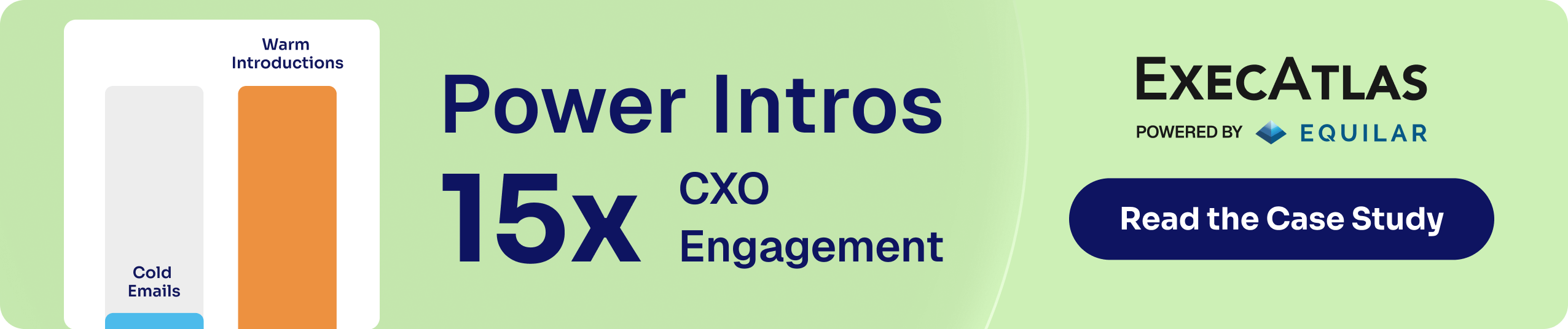
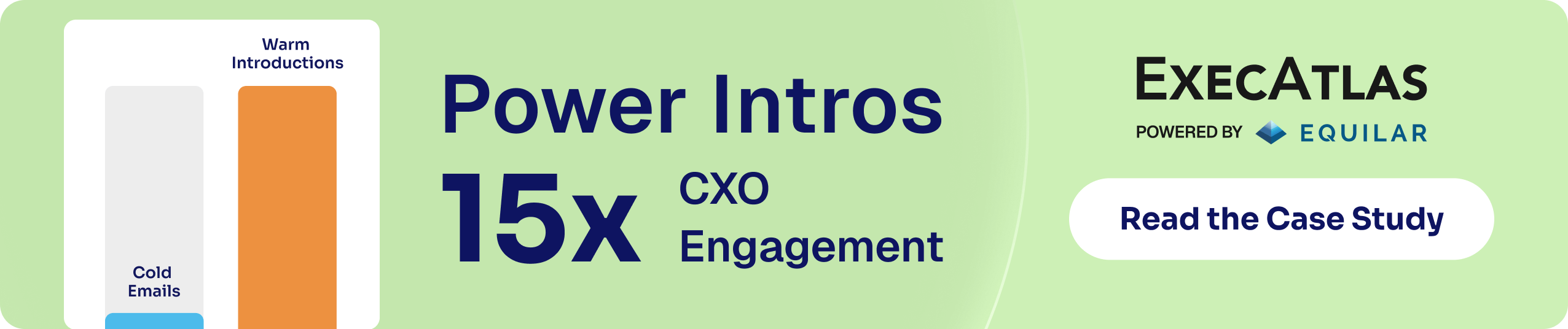
Stat to know: Engaging an executive through a warm introduction is 15 times more likely to generate a response than cold outreach.
Multi-Thread Into Buying Committees
High-value legal matters involve multiple decision-makers, but most CRM systems show individual contacts without mapping the full buying committee structure. Legal ops teams lack visibility into which executives influence matter decisions and which attorneys at the firm have relationships with each stakeholder.
What this looks like in practice:
Your firm pursues a large securities litigation matter at a public company
ExecAtlas maps the buying committee in CRM, showing relationship paths to the General Counsel, CFO, and two board members who will approve the engagement
Legal ops identifies which partners have verified connections to each stakeholder based on work history overlaps and board relationships
Business development coordinates outreach across all four decision-makers rather than relying on a single contact point
Stat to know: A multi-threaded approach has been shown to increase win rates by six times over single-threaded opportunities.
Champion Tracking in Real Time
Former clients who move to new companies represent immediate business development opportunities, but legal ops teams typically discover these transitions weeks or months late through manual LinkedIn monitoring or attorney-reported updates. By the time outreach happens, competitors have already established position.
What this looks like in practice:
A General Counsel who brought your firm multiple matters over three years accepts a new role at a healthcare company
ExecAtlas automatically updates the CRM record and sends an alert to legal ops and business development the day the transition is announced
Legal ops ensures the partner who worked most closely with the GC receives the notification immediately
The partner sends congratulations within 24 hours, and the GC brings the firm a regulatory compliance matter within the first quarter of their new role
Stat to know: Deal sizes increase by 19% when a past champion is involved, and engagements last 50% longer.
Stat to know: Deal sizes increase by 19% when a past champion is involved, and engagements last 50% longer.
Monitor Executive Transitions
Executive transitions signal opportunity, but most law firms discover these changes too late. Legal ops teams can't manually monitor thousands of executives for role changes, promotions, or company moves. Without automated tracking, CRM becomes outdated and business development teams miss time-sensitive opportunities.
What this looks like in practice:
A target company appoints a new CFO who previously worked at a firm where your corporate practice handled multiple transactions
ExecAtlas detects the transition, updates the CRM record automatically, and alerts legal ops and business development
Legal ops surfaces the work history connection to the relevant partner, who reaches out with a tailored message referencing their shared history
The new CFO responds positively and invites the firm to participate in an upcoming M&A process
How Legal Operations Teams Measure Executive Relationship Intelligence ROI
Legal operations leaders justify technology investment based on measurable impact, not feature lists. Executive relationship intelligence changes what CRM delivers.
Eliminated manual CRM maintenance: Legal ops teams spend countless hours chasing attorneys for contact updates, researching executive transitions, and manually enriching client records. Automated executive intelligence enrichment eliminates this work entirely, freeing legal ops to focus on strategic initiatives rather than data hygiene. The time savings alone justify investment for most firms.
Improved CRM adoption rates: Partners avoid CRM when it requires manual data entry without providing value. When CRM automatically surfaces warm introduction paths, relationship maps, and real-time transition alerts, it becomes a tool that helps attorneys win work. Legal ops teams consistently report adoption improvements when CRM delivers actionable intelligence instead of requiring administrative effort.
Higher business development conversion rates: Clean, relationship-rich CRM data enables business development teams to identify warm introduction paths, multi-thread into buying committees, and engage champions immediately after transitions. Firms that implement executive relationship intelligence report faster matter origination cycles and higher win rates on competitive pitches because outreach is based on verified relationships rather than cold contact lists.
Measurable data quality improvement: CRM data decay rates of 30-70% annually create significant business risk. Executive relationship intelligence maintains data accuracy automatically, ensuring contact information, titles, companies, and board positions remain current without manual updates. Legal ops teams can measure data quality improvement directly through record completeness, accuracy rates, and reduced duplicate entries.
The difference is measurable: CRM that business development actually uses, data quality that doesn't require constant manual maintenance, and relationship intelligence that drives revenue rather than administrative burden.
Executive Access Makes Deals Happen
Law firm CRM fails when it becomes an administrative system rather than a business development tool. Partners don't update records because the work is manual and the data doesn't help them win clients. Legal ops teams can't maintain data quality because tracking executive transitions and relationship changes requires constant manual research.
Executive relationship intelligence doesn't supplement traditional CRM. It transforms it. Legal ops teams using ExecAtlas eliminate manual enrichment work, maintain data quality automatically, and provide business development with relationship maps that enable warm introductions and multi-threaded engagement. These capabilities translate directly into CRM adoption, data accuracy, and revenue impact.
ExecAtlas provides the verified executive data, automated enrichment, and real-time transition tracking that make CRM systems valuable for business development rather than administrative burdens for legal ops.
Traditional enrichment tools append generic contact data but don't capture relationship context or work history overlaps. Executive relationship intelligence sources verified profiles from SEC filings and corporate disclosures, then maps relationship paths based on overlapping employment and board memberships. This gives legal ops teams relationship-rich data that partners actually use rather than generic contact records they ignore.
No. Executive relationship intelligence integrates directly into Salesforce and other existing CRM systems without requiring migration or replacement. Legal ops teams configure the integration once, and verified executive data, relationship mappings, and transition alerts flow automatically into existing records and workflows. This preserves your current CRM investment while solving the data quality and adoption challenges that limit its effectiveness.
Executive relationship intelligence sources data exclusively from public records including SEC filings, corporate disclosures, and verified board documentation. All data is publicly available and properly sourced, ensuring compliance with data privacy regulations. Legal ops teams maintain full control over which data fields enrich CRM and can configure the system to meet firm-specific compliance requirements.
ExecAtlas monitors executive transitions in real time and automatically updates CRM records when changes occur. Legal ops teams receive alerts about significant transitions affecting target accounts or past champions, and the system updates contact information, titles, and company affiliations without manual intervention. This ensures CRM data remains current and business development teams can act on opportunities immediately.
Most legal ops teams see immediate improvement in record completeness and relationship visibility within the first week as the system enriches existing contacts. Data quality metrics improve continuously as the system maintains accuracy automatically, eliminating the decay that occurs with manual update processes.
No. Executive relationship intelligence embeds directly into existing CRM workflows, so attorneys access enriched profiles, relationship maps, and warm introduction paths in the same interface they already use. Legal ops configures the integration once, and relationship intelligence surfaces automatically without requiring new logins, training, or process changes. This approach drives adoption because it enhances existing workflows rather than adding new ones.


 Products
 Industries